
Why Swell Period Changes Everything You See on the Water
Wave height is the number most surfers notice first, but it is rarely enough to predict how a session will feel. A buoy may report a swell at the same height on two different days, yet the waves can have completely different speed, shape, power, and consequence. An 8-second windswell and a 16-second groundswell with identical reported buoy height are not equivalent events. The shorter swell usually arrives as a busy, closely spaced train with limited reach into the seabed. The longer swell carries more organized energy, arrives with wider gaps between sets, and can stand up dramatically as it reaches a reef, sandbar, or point.
That difference should change every decision in the lineup, from where you sit to when you turn and paddle. A forecast becomes far more useful when swell height is read alongside period, direction, wind, tide, and local bathymetry. For surfers refining their understanding of how swell period affects wave size, the central lesson is simple: interval controls how quickly energy travels, where it begins to shoal, and how much power is concentrated into the breaking wave. Read the period correctly and raw chart data becomes practical positioning intelligence.
The Physics of Deep Water Energy and Coastal Shoaling
Swell period is the time between successive wave crests passing a fixed point, such as an offshore buoy. It is measured in seconds. A low-period swell has crests arriving close together, while a high-period swell has a longer interval between waves. That interval is closely connected to wavelength and propagation speed. In deep water, a longer-period wave travels faster and has a longer wavelength, allowing energy generated by a distant storm to cross an ocean basin in a more organized form.
The key transformation begins when the wave approaches shallow water. A wave starts to feel the seabed when the water depth is roughly less than half its wavelength, although the transition is gradual rather than a single switch. Because long-period waves have longer wavelengths, they interact with the bottom much farther offshore than short-period waves. This gives a 16-second groundswell more distance over which to refract, slow, focus, and build than an 8-second wind wave. The underlying principles are described in technical detail in this overview of wave shoaling mechanics.
As depth decreases, wave speed and wavelength reduce. Outside the breaking zone, the energy flux is approximately conserved, so the wave reorganizes that energy into a taller, steeper form. Since wave energy is proportional to the square of wave height, even a modest increase in height represents a significant concentration of energy. Real waves are also affected by refraction, diffraction, currents, bottom friction, and opposing wind, so the result is never perfectly uniform. Still, the practical sequence is dependable: a long-period swell slows over the shelf, steepens over a rising reef or bar, and then releases a concentrated burst of kinetic energy when it breaks.
- Longer wavelength: the wave feels the seabed earlier and begins transforming farther from shore.
- Greater organization: distant groundswells usually arrive with cleaner direction and more defined sets.
- Stronger shoaling response: reefs, channels, sandbars, and points can amplify or redirect the wave more sharply.
- Higher consequence: the same forecast height can produce a faster, thicker, more powerful breaking wave at a long interval.
Bottom contour determines how that energy is finally expressed. A gradual sandy slope may produce a spilling wave, while a steep reef edge can turn the same incoming energy into a plunging, hollow peak. Research on Croyde Beach demonstrates how an offshore reef can focus refracted waves into A-frames and shift the location of quality peaks as the tide changes. The forecast tells you what is arriving offshore; bathymetry tells you where that energy will become surf.
Short Swells Versus Groundswells Across the Spectrum
Period categories are not rigid laws, and local breaks can make a 10-second swell behave differently from another 10-second swell. However, the broad distinctions are useful. Short-period swells, generally under 9 seconds, are often generated by nearby winds. They can be energetic but disorganized, with waves packed closely together and less time for each peak to develop a clean face. Medium-period swells around 10 to 13 seconds tend to show better shape and more defined sets. Long-period groundswells at 14 seconds or longer carry the greatest potential for early shoaling, fast takeoffs, and powerful wave faces.
| Period range | Typical character | Lineup implications |
|---|---|---|
| Under 9 seconds | Closely spaced windswell, softer or choppier faces, frequent waves | Shorter lulls, more scrambling, takeoffs often less defined |
| 10 to 13 seconds | More organized energy, clearer peaks, moderate speed | Readable sets, improved face quality, earlier positioning becomes important |
| 14 seconds and above | Fast groundswell, longer wavelength, powerful shoaling and steep faces | Longer lulls followed by concentrated sets, outer peaks and cleanup waves demand respect |
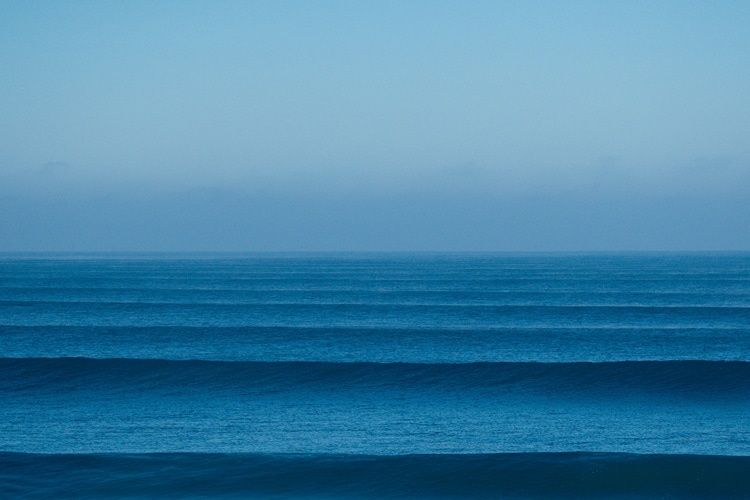
Long-period waves often create a misleading rhythm. The ocean may look quiet for several minutes, encouraging surfers to drift inward or relax their readiness. Then a set arrives with more speed, more size, and a wider impact zone than the visual lineup marker suggested. The first wave may break on an outer reef or sandbar, while the following waves refract and bend into areas that looked safe moments earlier. This is why forecasts should be read as a combination of factors rather than reduced to a star rating or a single wave-height number. A useful guide to combining swell, wind, direction, and tide is available through forecast interpretation beyond star ratings.
Positioning Your Board to Avoid the Impact Zone
On a short-period day, the visible pack often forms near the area where waves are consistently breaking. On a long-period day, that pack can become a poor reference point. The main breaking zone may sit farther outside, especially over a shallow reef or a distant sandbar, while the inside remains deceptively calm between sets. Sitting at the visual center of the crowd can place you directly in the path of the largest wave of the set. The safer question is not “Where is everyone sitting?” but “Where does the swell first begin to stand up and where will the next wave travel?”
Spend time identifying the true primary takeoff zone before committing to a position. Watch for a darker line on the horizon, a change in surface texture, or a slight lifting of the ocean beyond the familiar peak. Follow the first wave of a set across the break. Does it refract toward the shoulder? Does it break on an outer shelf and then reform inside? Does a channel offer a clean exit, or does the current pull directly across the impact zone? A high-resolution understanding of the bottom can be especially valuable because reefs and bars may focus incoming energy into peaks that are not obvious from the beach.
- Watch at least two or three full sets before paddling into the main lineup.
- Mark the outermost breaking wave, not just the average breaking position.
- Identify a channel or shoulder that provides an exit route if caught inside.
- Stay clear of the direct fall line beneath the peak when the wave face becomes steep or hollow.
- Expect the rip to strengthen when larger, longer-period sets push water shoreward.
High-volume intervals can generate powerful rip currents because each set moves a large amount of water toward the beach. The rip may accelerate during the set and appear to weaken during the lull, creating a false sense of security. Manage the session in cycles: observe during the lull, move decisively before the next set, and avoid paddling directly against a strong current when a lateral escape route is available. If caught inside, protect the head, keep the board controlled when appropriate, and prioritize a clear path away from other surfers. Spot-specific knowledge matters, and no forecast can replace a realistic assessment of ability, crowding, tide, and rescue options.
Paddle Mechanics and Timing for Faster Moving Waves
A fast groundswell peak does not reward last-second effort. The wave may travel beneath the board sooner than expected, and the face can pitch from manageable to vertical in only a few strokes. Paddling early creates forward momentum, but the aim is not to sprint blindly toward every approaching lump. The goal is to match the board”s speed to the moving peak, then let the wave provide the final acceleration. Paddling too far ahead can push the nose down the face prematurely, while starting too late leaves the board behind the wave.
- Read the peak before turning. From a seated position, watch whether the swell is lifting evenly or beginning to steepen on one side. Turn toward the intended direction rather than pointing straight at the beach by habit.
- Transition smoothly. Place the hands, bring the chest forward, and settle into the board”s efficient paddle position without repeated adjustments. The board should already be aimed when the first committed strokes begin.
- Build speed progressively. Start with strong, clean strokes as the wave approaches, then increase cadence when the tail begins to lift. Keep the head low enough to maintain trim, but look toward the open face rather than down at the nose.
- Commit at the right moment. Once the wave has engaged the board, stop hesitating. Shift weight forward enough to match the slope, then pop up quickly and place the feet accurately.
The seated-to-prone transition deserves deliberate practice in small, controlled surf. A useful drill is to sit facing the horizon, turn the board toward an imaginary peak, lie down without crawling or wobbling, and begin paddling from the correct trim point. The movement should become automatic before it is tested on a steep takeoff. On longboards, sitting and turning late can help preserve energy and prevent over-paddling, but the timing must be precise. The incoming wave should add momentum, not catch a stationary board with the nose pointed too high.
Equipment should support timing rather than compensate for poor positioning. A board with excessive tail volume, a very wide tail, or limited tail rocker may sit high on a steep face and resist the clean drop into the pocket. Conversely, a highly rockered, narrow board may fit a hollow wave but demand more speed and precision from the surfer. Volume should provide enough flotation for efficient paddling without making the board difficult to control once the wave pitches. When long-period surf becomes faster, test equipment in progressively larger conditions and prioritize a board that matches skill, fitness, takeoff ability, and the break”s bottom shape.
Master the Interval and Transform Your Next Session
Reading swell period turns a forecast from a collection of numbers into a tactical map. Wave height estimates the available scale, but period helps reveal speed, wavelength, set spacing, shoaling distance, and likely power. Direction determines which parts of the coast receive the energy, while tide and bottom contour decide where that energy becomes a rideable face or a dangerous impact zone. When those variables are read together, lineup positioning becomes deliberate rather than reactive.
Before the next paddle out, spend ten minutes on the beach, cliff, or access path watching complete sets. Count the seconds between crests, note where the first wave stands up, track how far the largest wave travels, and identify the channel before entering the water. Then adjust the plan: sit farther outside if the swell is long and the reef is focusing energy, conserve energy during extended lulls, and begin paddling earlier when the peak is moving quickly. Ride with intention, keep the exit route in mind, and let the interval guide every decision from first glance to final wave.